
My dad has been keeping his muscles strong his entire life. He started lifting weights as a young man and for as long as I can remember we had a home gym in the garage that Dad used on a regular and frequent basis. On Dad’s 80th birthday he performed 40 x 20kg bicep curls on each arm, and not that long ago I timed him while he held the plank position for two minutes. Two minutes! Have you ever tried to plank for ONE minute? Thirty seconds is about my limit! And sometime in the late 1970’s he discovered protein shakes, which he called ‘Muscle Milk’. The result of Dad’s commitment to muscle strength and general fitness not only gave him a great physique, it enabled him to excel in Master’s athletics (he still carries the masters pole vaulting record for his age group in South Australia).
Even more importantly, Dad’s commitment has set up his body to be strong, resilient and well-functioning in older age. A few months ago he unfortunately fell and broke his hip, requiring a full hip replacement, however, thanks to his dedication to his overall health, and his strength maintenance in particular, Dad’s recovery was nothing short of astounding. His surgeon told him later that while he was operating he could see that Dad had good muscle tone and that this contributed greatly to his excellent recovery.
There are two key strategies to maintaining muscle mass: one is strength training and the other is ensuring we consume enough protein. The rest of this blog will cover the protein piece of the puzzle and a future blog will cover strength training.
Protein to Prevent Sarcopenia
So why is protein so important as we age? Because a condition called sarcopenia, characterised by loss of muscle mass and function, is a natural part of ageing. From about the age of 40 we lose 1% of muscle mass each year, so by the time we hit 70 we are probably working with about half the muscle mass we had in our twenties (Frank Lipman MD, The New Rules of Ageing Well).
Minimizing the loss of muscle is a priority for aging well and the importance of proactively maintaining muscle mass increases with age.
In a 2018 study that followed more than 2,900 seniors over 23 years, researchers found that those who ate the most protein were 30 percent less likely to become functionally impaired than those who ate the least amount. Functionality is defined as being able to perform daily tasks with ease.
People don’t end up in nursing homes because they’re sick, they end up in nursing homes with wasted muscles, hardly able to get out of a chair. And they fall more easily because they’re unsteady on their feet. So a key strategy to ensuring healthy ageing and avoiding frailty that comes with old age is focusing on muscle mass and muscle strength. The good news is that it’s never too late to start building muscle!
How much protein?
What is the right amount of protein to reduce the impact of muscle wastage? How can we ensure we eat as much protein as we need for muscle growth? It depends on how much you weigh and how old you are. For adults up to age 65, 0.8-1.0 grams of protein per kilogram of weight is recommended per day. For instance, a 50 year old woman weighing 60kg (132 pounds), will need up to 60 grams of protein a day. A study by European experts recommends that older adults from the age of 65 increase their protein intake to at least 1.0 to 1.2 gms of protein/kg body weight/day. That same 60kg woman when she reaches age 65 should now be consuming around 75gm of protein a day.
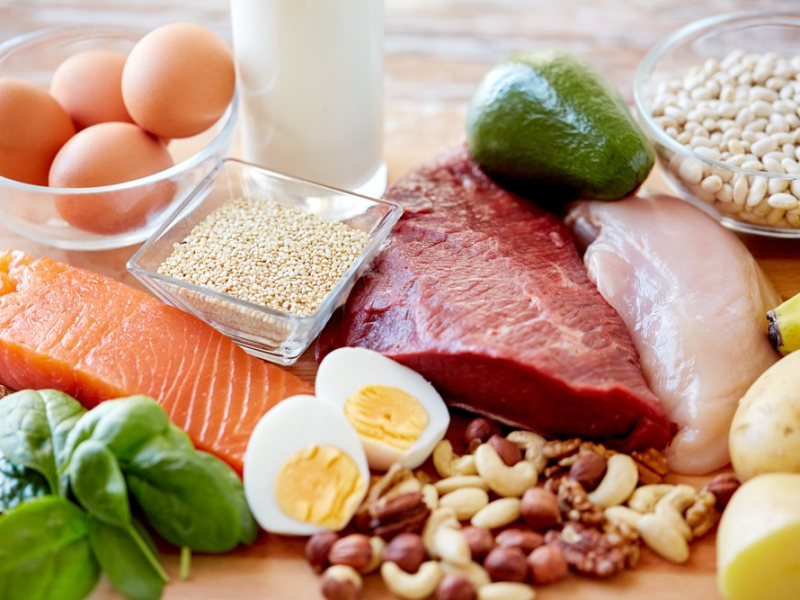
To put that into perspective, 100gms of beef, chicken, lamb, fish or pork has 30gms of protein. A 200 gm tub of Greek yogurt has 10 grams; 3Tb cottage cheese 14 grams; 40 gms of hard cheese 10gms; 1 cup full cream milk 8 gms; a half-cup of lentils 9 grams; ¼ cup raw nuts 8 gms; 1 medium egg 7gms. (To check the protein content of other common foods, click here).
Dr. Elena Volpi, a professor of geriatrics and cell biology at the University of Texas Medical Branch in Galveston, Texas advises that, in addition to the amount of protein consumed, there is also a need to spread the consumption throughout the day. She says “If I eat too little protein during a meal, I may not adequately stimulate the uptake of amino acids into skeletal muscle. If I eat too much, say from a large T-bone steak, I won’t be able to store all of it away.”
Based on her research, Volpi suggests that older adults rethink what they eat at breakfast, when protein intake tends to be lowest. “Oatmeal or cereal with milk isn’t enough; people should think of adding a Greek yogurt, an egg or a turkey sausage,” Volpi said.
Here are 14 easy ways to increase protein intake
- Eat your protein first
- Snack on cheese
- Replace cereal with eggs
- Top your food with chopped almonds
- Choose Greek yogurt
- Have a Protein Shake for breakfast
- Include a high-protein Food with every meal
- Choose leaner, slightly larger cuts of meat
- Add peanut butter to your diet
- Eat lean jerky
- Indulge in cottage cheese at any time
- Munch on edamame
- Eat canned fish
- Eat more whole grains
How Much of a Role Should Protein Shakes Play in Overall Protein Consumption?
While it is widely agreed that eating whole foods is always preferable, the right protein shake can supplement protein intake and provide an additional protein boost. Depending on the brand, protein shakes can have the added benefits of providing a nutrient boost too and effectively battling hunger if weight management is a goal.
Protein shakes can be an easy nutritious start to the day, especially for those short on time in the morning. Quick, portable, nutritious protein shakes can be tailored for your specific taste and preferences by adding berries and other fruit, spinach or kale and a healthy fat like avocado or nut butter.
Finding a protein shake that suits your needs can be difficult with so many products on the market, both in shops and online. I highly recommend this delicious and nutritious one from my own store. It delivers 20gms of vegan protein with 20 vitamins and minerals and all the essential amino acids to help support muscles. The plant-powered protein is derived from peas, rice and cranberries and it can be blended with a variety of fresh fruits and vegetables to further support nutrient values and taste.
To sum up… throughout adult life consuming an adequate amount of high quality protein throughout the day may prevent the onset or slow the progression of sarcopenia (loss of muscle mass). Paying particular attention to your protein intake from the age of 65 will contribute to maintaining a strong and well-functioning body in the later decades of life.
Latest Posts




Find me on Instagram

 Forever Fit and Fun with Jill Andrews